
Victron Energy
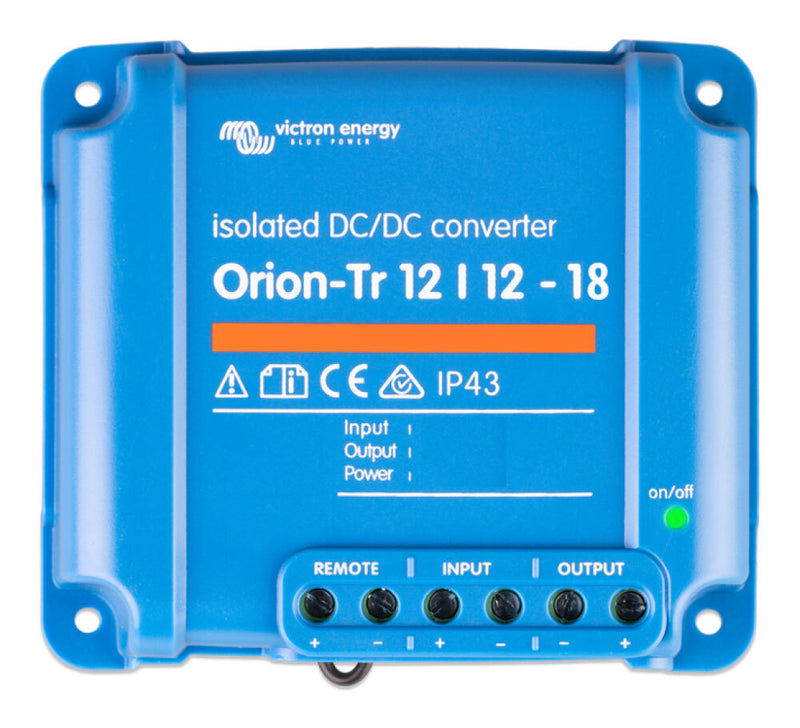
DC-DC Converter | Victron | Orion-Tr 12/12-18A (220W) Isolated DC-DC converter
Product Details
The Victron Orion-Tr 12/12-18A is a galvanically isolated DC-DC converter rated at 18A continuous output (220W) at 40°C — the real-world sustained figure you can actually plan around. It takes a 12V source input and delivers a regulated 12V output, with full 200V DC isolation between the input circuit, output circuit, and chassis. Suited to dual battery systems in 4WDs, marine house battery setups, and any application where two 12V systems need to operate independently without a shared ground path.
Important: This is a DC-DC voltage converter, not a battery charger — it outputs a fixed regulated voltage and does not perform multi-stage charging profiles (bulk/absorption/float). If you need to charge a secondary battery directly from your alternator, see the Orion-Tr Smart Isolated 12/12-18A (SKU ORI121222120), which adds Bluetooth and a 3-stage adaptive charging algorithm.
Key Features
- 18A continuous output at 40°C (220W nameplate) — the rating that matters in a hot engine bay or QLD summer. At 25°C the unit can sustain up to 280W, but 220W is the conservative figure to design to.
- 200V DC galvanic isolation — input and output share no electrical connection, not even a common ground. Energy transfer is magnetic, through an internal transformer. This eliminates ground loops that cause electrolytic corrosion in marine and automotive installations, and stops fault currents from crossing between circuits.
- Adjustable output voltage (10–15V) — onboard potentiometer lets the installer trim output within the range, compensating for cable voltage drop over long runs or fine-tuning to specific load requirements.
- Remote on/off terminal — low-current switched input (<100mA) allows the converter to be enabled and disabled by an ignition signal or a lightweight switch, without running a high-current switching circuit through the main cable. A wire bridge is fitted by default so the unit runs permanently until the bridge is removed and a control signal wired in.
- Parallelable — unlimited units — run multiple converters output-to-output to increase total current capacity. Output voltages must be matched via the potentiometer before paralleling.
- Short circuit proof — the output self-protects and recovers automatically after a wiring fault. No fuse replacement or manual reset required.
- IP43 (terminal-down mounting) — rated for under-bonnet and exposed locations when mounted with screw terminals oriented downward. IP43 is conditional on this mounting orientation.
- Buck-boost topology — maintains stable 12V output across the full 8–17V input range, including during engine cranking when alternator voltage dips below nominal. The output does not sag with the source.
- No Bluetooth or app connectivity — this is a non-Smart model. Configuration is via the onboard potentiometer only. There is no VE.Direct port and no wireless interface.
Specifications
| Parameter | Value |
|---|---|
| Electrical | |
| Nominal input voltage | 12V |
| Input voltage range | 8 – 17V |
| Under-voltage shutdown | 7.0V |
| Under-voltage restart | 7.5V |
| Nominal output voltage | 12.2V |
| Output voltage adjust range | 10 – 15V (onboard potentiometer) |
| Output voltage tolerance | ±0.2V |
| Output noise | 2 mV rms |
| Continuous output current @ 40°C | 18A |
| Maximum output current (10s burst) | 25A |
| Short circuit output current | 40A |
| Continuous output power @ 25°C | 280W |
| Continuous output power @ 40°C | 220W |
| Efficiency | 87% |
| No-load input current | < 80 mA |
| Current draw when disabled via remote | < 200 µA |
| Isolation | |
| Galvanic isolation | 200V DC — input, output, and case |
| Environmental | |
| Operating temperature range | -20°C to +55°C |
| Thermal derating | 3% per °C above 40°C |
| Humidity | Max. 95%, non-condensing |
| IP rating | IP43 (terminals-down mounting only) |
| Mechanical | |
| Dimensions (H × W × D) | 130 × 186 × 70 mm |
| Weight | 1.3 kg |
| DC connection | Screw terminals |
| Maximum cable cross-section | 16 mm² (AWG6) |
| Communication & Control | |
| VE.Direct | None |
| Bluetooth | None |
| Remote on/off | Yes — green connector, <100mA switched current |
| Protection | |
| Short circuit protection | Yes — self-recovering |
| Over-temperature protection | Yes — derates above 40°C, shuts down at thermal limit |
| Input fuse | Internal, non-replaceable |
| Paralleling | Yes — unlimited units (match output voltages first) |
| Certifications | |
| Safety | EN 60950 |
| Emission | EN 61000-6-3, EN 55014-1 |
| Immunity | EN 61000-6-2, EN 61000-6-1, EN 55014-2 |
| Automotive EMC | ECE R10-5 |
Typical Applications
- Dual 12V battery systems in 4WDs and camper trailers — powers or supplements a secondary house battery bank from the starter battery, with galvanic isolation preventing ground loops and chassis corrosion between independently bonded systems.
- Marine house battery isolation — separates the engine/starter battery bank from the house bank, eliminating the electrolytic corrosion caused by stray DC currents between dissimilar underwater metal fittings.
- Stable 12V power for sensitive loads — supplies fridges, inverters, communications equipment, and marine instruments with a clean, stable 12V rail, isolated from alternator ripple and engine ignition noise on the chassis ground.
- Caravans and trailers with separate chassis grounds — allows the tow vehicle's 12V system to power an isolated house battery bank without a shared ground path, suitable where the trailer has its own independently bonded chassis.
Isolated vs Non-Isolated DC-DC Converters: What's the Difference?
A galvanically isolated converter transfers energy between its input and output circuits using magnetic coupling — there is no direct electrical connection, and no shared ground, between the two sides. Inside the unit, a high-frequency transformer handles the energy transfer. The result is that a fault, stray current, or corrosion-driving potential on one side cannot reach the other. This matters in marine installations, where stray DC currents between dissimilar underwater metals accelerate electrolytic corrosion, and in vehicles with independently bonded chassis where a shared ground would couple the two systems together. The Orion-Tr (this unit) and the Orion-Tr Smart Isolated are both isolated converters.
A non-isolated converter is simpler: it connects input and output through a shared common ground, using an inductor rather than a transformer to regulate voltage. It is smaller, lighter, and cheaper for the same power rating, but it cannot separate two circuits that need to be electrically independent. Non-isolated converters are appropriate where both circuits share the same chassis ground — for example, powering a 12V accessory rail directly from the vehicle chassis. Victron's Orion-Tr non-isolated family covers this use case. If your installation involves marine corrosion risk, mixed-ground systems, or any scenario where fault isolation matters, use an isolated converter.
Installation Notes
- IP43 rating requires terminals-down mounting. Mount the unit with screw terminals facing downward to achieve the rated IP43 ingress protection. Any other orientation reduces the effective IP rating.
- Cable sizing: Maximum cable cross-section is 16 mm² (AWG6). Size input cables for the full input current draw, not the output current — at 87% efficiency and 18A output, allow for approximately 20–22A at the input and fuse at the source accordingly.
- Reverse polarity: Reverse polarity protection is not specified for this model. Always verify polarity before connecting and fuse the input at the source.
- Remote on/off: The green remote terminal connector ships with a wire bridge fitted, which keeps the unit permanently on. To enable remote switching, remove the bridge and wire a low-current (<100mA) ignition signal or switch to the terminal. Connect to the engine run signal for automatic enable/disable with the vehicle.
- Paralleling: Adjust both units to identical output voltages using the onboard potentiometers before connecting outputs together. Mismatched outputs will cause one unit to back-feed the other.
- Thermal derating in hot climates: Output current derates at 3% per °C above 40°C. In a QLD under-bonnet environment at 60°C ambient, available output drops by approximately 60% of nameplate — plan for adequate ventilation or derate your load accordingly. The unit shuts down safely at its thermal limit and recovers when cooled.
Frequently Asked Questions
- Is this a battery charger?
- No. The Orion-Tr 12/12-18A outputs a fixed regulated voltage and does not run multi-stage charging profiles (bulk/absorption/float). It will power a 12V load reliably, but it will not correctly charge a battery. For direct isolated battery charging from an alternator, use the Orion-Tr Smart Isolated 12/12-18A (SKU ORI121222120), which adds Bluetooth and a 3-stage adaptive charging algorithm.
- Can I use it with a LiFePO4 battery?
- You can power a LiFePO4-based load from the output side of this converter, but it will not charge a LiFePO4 battery correctly — LiFePO4 cells require a specific voltage profile that this non-Smart unit does not provide. Use the Orion-Tr Smart Isolated 12/12-18A if direct battery charging is your requirement.
- What's the difference between the Orion-Tr and the Orion-Tr Smart?
- The non-Smart (this unit) outputs a fixed adjustable voltage — it is a load converter, not a charger. The Orion-Tr Smart adds Bluetooth, VictronConnect app control, and a 3-stage adaptive charging algorithm that makes it suitable for direct battery charging. If your application is powering loads rather than charging a battery, the non-Smart is the right choice and costs less.
- Does it need a remote on/off signal?
- No. A wire bridge is fitted across the remote on/off terminal by default, which keeps the unit permanently on whenever input power is present. Remove the bridge and connect a low-current (<100mA) switched signal — such as an ignition output — if you want the converter to enable and disable with the vehicle.
- Can I run multiple units in parallel?
- Yes — the Orion-Tr supports unlimited units in parallel. Before connecting outputs together, adjust both units to identical output voltages using the onboard potentiometer on each unit. Mismatched output voltages will cause the higher-voltage unit to back-feed the lower, which can cause damage or erratic behaviour.
Stocked by Revolution Power Australia — authorised Victron Energy resellers, shipping Australia-wide from Coomera QLD. Contact us for application advice.